Showing posts with label Books. Show all posts

Saturday, October 13, 2012

Review: The Fifth Science Fiction Megapack

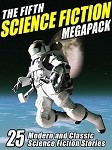
The Fifth Science Fiction Megapack from Wildside Press is a collection of 25 “modern and classic science fiction stories.” It’s also the first of Wildside’s megapacks that I’ve read. At a very affordable price of $0.99, it’s hard not to like. In fact, I only have one negative thing to say about this ebook: The cover art doesn’t really fit the contents. I’m sorry to have to say that; I know the kind of effort that goes into choosing cover art. The floating astronaut connotes, to me at least, tales of hard science fiction – rocket ships, spacemen, and hard science. While the hard stuff is certainly represented, this collection is much more than that in scope.

Ranging from the opening tale of how robots learn emotions to the story of a retired super heroine’s legacy, to the tale of how the grooming of a planet’s cultural development failed, every story is fresh and different. There’s even a good Nazi story, sort of. I finally understood what this collection is all about when I read Peacemaker by Gardner Dozois. It is a dark tale about a bleak and depressing future. When I finished the story, at first I wondered why the editors chose to include it here and not in one of their horror collections. My very next thought was, “Well, it would make one hell of a good episode of The Twilight Zone.” And that thought can be applied to most of the stories here.

The stories are excellent choices for a wide audience. Overall, this ebook is a steal at only a dollar, but more importantly, it’s well worth the read. Now I’m off to read the Cthulhu Mythos Megapack (which I purchased while reading this one), and then I want buy the Macabre Megapack.


Now reading: Necroscope III: The Source by Brian Lumley

Tuesday, March 01, 2011

Soulless

Book review: 2011.01

Author: Gail Carriger

Gail Carriger's series came to my attention via Mighty Mur Lafferty's podcast (I Should Be Writing), I think. My wife gave them to me for Christmas last year, and they've been a delightful gift.

To be honest, I'm not sure why I liked Soulless as much as I did. It's Victorian era fantasy with a thick layer of steampunk frosting. This is good, I like both of those things. It also has vampires, werewolves, and ghosts openly existing in society among normal humans, and I don't like that. Monsters are supposed to be just that – monsters. They belong in the dark. But in this series, they are an integral part of society and Carriger has created a strong world where these 'monsters' are strongly integrated into the culture, society, and history. The setting is internally consistent, and crafted well, so I was able to forgive the things I don't usually like.

The main character, Alexia Tarabotti, is loveable because she's a misfit within Victorian society. Tall, dark complected, with a non-dainty nose and full figure, she's practically a pariah, especially compared to her mother and two step-sisters. Add to this an inquisitive mind and she's clearly doomed as a potential wife.
But Alexia has a secret. She doesn't have a soul, which really isn't as terrible as it sounds.

The author alludes that it's Alexia's soullessness that is likely the cause of her heroic nature. Soulless people are a rare species, called preternaturals, who are juxtaposed with the supernatural caste of vampires, werewolves, and ghosts. And preternaturals were historically the nemeses of the monsters. They were the monster hunters. And this puts Alexia at odds with the supernatural community.

More than the setting, which as I said, is very logical and internally consistent, it's the characters that I like. Carriger populates this silly setting with some fun characters and each one is a person unto themselves. Personally, I really want to see more of the Scarlet Pimpernellian Lord Akeldama and his cadre of spies…please Gail!

In truth, the story is as much a romance story as it is scifi/fantasy, and Carriger handles her stuff well in both courts. She does a masterful job of handling character relationships and interactions, especially the friendly ones. The characters are fun and their interactions are realistic. Characters put as much importance on society, appearance, and etiquette as they do the story at hand, and most characters have their own perspectives on the world around them. Their own motivations guide their actions, whether that is spying on the vampire hives or finding right hat or cravat for the day's activities.

The book is full of humor, full of adventure, and definitely a fun read. If Kim Harrison and Jane Austin got together to write a book, it might come close to this. My defining keywords for this book are: character, steampunk, adventure, humor, espionage, and romance; in that order.

As I'm writing this, I've nearly finished the second book in the series, Changeless. Alexia's Cinderella story has come true and this book finds the city embroiled in a panic as the supernatural denizens of London are rendered completely mortal for a day. Alexia is on the case trying to figure out the cause of this calamity.

This novel further develops the history of Carriger's setting, expanding what we know about the roles the supernatural elements have played in the past. We get more clues about Alexia's father and the nature of their species, the preternaturals. And the author treats us with some delightful new characters, including a cross-dressing, counter-culture mad scientist and a pack of Scottish werewolves. Steampunk elements feature very strongly in this story as well. Thus far, there are still no zombies, but I'm holding out hope for the third book on that note.

Changeless does everything a second-book should and it's been a fun read. I'm only about fifty pages from the end and plots are starting to be resolved, thanks to the unladylike willfulness of our heroic main character. Again, thanks to my wife, the third book is on my book shelf, and I just discovered that the fourth will be out soon. I'm looking forward to both!

Tuesday, September 21, 2010

Abraham Lincoln: Vamire Hunter

Book review: 2010.13

Author: Seth Grahame-Smith

It's finally happened. I'm reporting on a book that I didn't like. I picked up this one for two reasons: I like Abraham Lincoln, and I really liked G-S's Pride and Prejudice and Zombies. That book is responsible for creating a whole new niche of horror fiction. Most of which is completely unimaginative and likely deplorable. I say that in a most uneducated fashion. I haven't read anything else in this niche besides these two. It's a kitzchy fad that hopefully will pass soon. Having proclaimed that, I need to read a few more works in this revisionist subgenre by other authors. There are sure to be some gems out there.

Anyway, the one thing I really didn't like about P&P&Z was the writing style. But, since I read the source material simultatneously, I could see that he was mimicking Jane Austen's style, which was appropriate for that book. Unfortunately, Grahame-Smith was channeling Austen again for this book. It is written in that same plodding, overly introspective narrative style. That might have been appropriate for a period work about a teenaged girl, but it just made this story languish.

Secondly, where this story could've portrayed Abe in a larger-than-life, even-more-heroic fashion, it instead reduces him to being a victim of his lot in life. It makes out Abe Lincoln to be nothing more than a reactive person whose every decision was done as a reaction to his fear of and desire for vengeance against vampires.

The one thing I did like was the author's take on vampires. His interpretation of the lore was modern and interesting. In some ways, it was similar to Anne Rice's vampires. Hmm. For that matter, he also used a similar story framing technique as she did in Interview with the Vampire.

In summation, I was bored all the way through this book. I kept waiting for the exposition to end and the real story to begin, but it never did. It was exposition all the way through. I think the story downplayed the protagonist's potentially heroic nature, and the writing style wasn't appropriate for the era. Edgar Allan Poe makes a guest appearance; it would've been more appropriate to write this in his style. Maybe this style is the author's true form; other than these two books, I haven't read any of his other works.

Saturday, September 18, 2010

Boneshaker

Book review: 2010.12

Author: Cherie Priest

I bought Boneshaker, plain and simply, because I wanted to read a steampunk novel. As steampunk, Boneshaker satisfies. There are goggles, in this case, full-on gas masks, airships, and steam-powered air generators. And it takes place around the turn of the century. So steampunk requirements satisfied.

I'd also categorize the book's setting as dystopian. It's dark, grimy, and a bit depressing. I tend to envision my steampunk as more fun, frolicky, and, well, quaint. Wild, Wild West; Girl Genius; The League of Extraordinary Gentlemen.

This book is more akin to Brave New World or Make Room! Make Room! (that's the Harry Harrison novel that the movie Soylent Green was based on - if you can read it and NOT attempt suicide, then you're doing something right). Or Romero's Dawn of the Dead. It's a bit depressing.

But that's just the setting. The story takes place in a post-Civil War era Seattle. It's a dark and dismal setting that brings forth connotations of real-world coal mining country and stories like that of Matewan, West Virginia. It's grimy, and in more ways than one.

The story at its base is a mother-son redemption story. Not just redemption of their relationship, but also of their identities. The mother is the central character and, while at first seeming like the stereotypical failure as a single parent, she is quickly driven to levels of badassery as she forays into the wasteland to rescue her wayward teenage son.

Mother and son both suffer from a tainted past, borne on the coattails of the long lost husband/father. One of the central plot points revolves around his past actions and apparent demise. Heck, the current and future state of the world is a direct result of his past actions. Did I mention the zombies? The wayward teenage son sets out to determine the truth about his father. Meanwhile, the mother takes on the mantle of her father and tries to rescue the son.

This book is a great read - I read it over the course of about four days. For me, that's the equivalent of other people saying they read the latest Harry Potter book over the weekend. I read slowly and I'm a critical reader, very conscious of style and word choice, which means I read slower still. This book held my attention as Priest immersed me in her world of steam and toxic gas. I loved every minute of it.

If my praise leaves you unsure, then consider that both Warren Ellis and Cory Doctorow liked it. But then, that might not mean much to you either. In that case, go read whatever the hell everyone else is reading. I'm just trying to show you something different.

The author has a follow-up book, Dreadnought, coming out soon. It's not a sequel, but it's set in the same world. For that reason alone, I'll be reading it too.

Sunday, September 12, 2010

Countdown to Armageddon

Book review 2010.11

Author: Edward M. Lerner

Countdown to Armageddon is the front half of a new flip-book by Edward M. Lerner. The other half of the book is a collection of short stories called A Stranger in Paradise.

Countdown to Armageddon is a short novel about time travel, terrorists, spies, and love. Time travel is a topic that I hate because it's rarely done well and often creates more plot holes than it fixes. But in the hands of an accomplished sci-fi author like Lerner, it's put to good use.

I really like his philosophy of time as a linear stream with a fixed rate of speed, and his stance (in this story) that time travel cannot create divergent realities. The main character refers to that popular notion as preposterous because of the immense amount of energy that would be needed to create those realities. So Lerner very clearly sets up the premise that there's only one reality and it's very difficult to alter it. That means we're playing for keeps; no temporal take-backs. (Sort of. Time travel never plays by the rules.)

The crux of the story is about two men who take a one-way journey back through time chasing a terrorist who is armed with an atomic bomb, and who intends to change history by having the Moslems defeat the Christians back in the day. The main character, Harry, is a historian and armchair physicist. Both of these areas of expertise come into play when he is approached by Terrance, a former Interpol agent, now fellow historian, to track down the villain.

This book is also part love story. Harry's chief motivation for saving the world is his love for his wife, Julia. Sounds sappy, I know, but Harry and Julia are a great quirky couple and we get to see glimpses of their relationship and love.

Now, one thing I liked about this story is that it capitalized on an era of time that I (and likely most readers) know very little about. Taking place in the 8th century, ancient Europe is just starting to settle into its modern geo-political structure.

Because of my lack of familiarity with them, it was sometimes hard for me to keep the political groups straight. Lerner keeps the story moving at a steady pace and never falls into the trap of diverging into an extended history lesson. Just like with the main love story, Lerner only gives us what the story needs to keep moving forward.

There was only one scene in the book that I thought was unnecessary: a very short scene early in the story when Julia is having lunch with her sister. The scene is there to affirm that Julia really does love Harry and to broaden her characterization, but it's unnecessary because Lerner does a great job characterizing their relationship all through the story. She's awesome and easily worth the risk of Harry's life and future. Ah, there's that time travel thing again.

On to the other half of the book. A Stranger in Paradise is a small collection of short stories where we can see the breadth of Lerner's writing style. These stories were varied in theme and setting, and I enjoyed them all.

Overall, I liked this book a lot. I found it to be fresh and interesting, and the format allowed me to read more deeply of an author I'd never read before. I'll be looking into some of Lerner's other works. And I'd really love to see more of Harry Bowen!

More books on the way

Before anyone gives me flack, yes, I know I'm behind on my book reviews. I'll try to catch up on them soon. The good news is that I actually have been reading. I just haven't been posting. Additionally, thanks to a friend, the family and I had the opportunity to try out a few fun games, so I want to post about them too.

In lieu of actual reviews, here's a list of what I've read over the last few months, many of which I do want to write reviews for. Let me know if there are any that you're interested in hearing about.

Books:
Countdown to Armageddon / A Stranger in Paradise by Edward M. Lerner
A Dance with Demons by Jeff Offringa
Something from the Nightside by Simon R. Green
Nocturnal by Scott Sigler
Boneshaker by Cherie Priest (and she just released another book in the same setting)
Blood Rites and Death Masks by Jim Butcher
Bimbos of the Death Sun by Sharyn McCrumb
Beneath by Jeremy Robinson
Brave Men Run by Matthew Wayne Selznick
The Secret World Chronicle, Books 1 & 2 by Mercedes Lackey & Steve Libbey
Playing for Keeps by Mur Lafferty
How to Succeed in Evil: The Novel by Patrick McLean
New World Orders by Edward G. Talbot

Comics:
Sword by the Luna Brothers
Ex Machina by Brian K. Vaughan & Tony Harris
Chew by John Layman & Rob Guillory
Astro City: Dark Age by Kurt Busiek & Brent Anderson

Now listening to: The Bear Swarm! podcast 

Friday, June 11, 2010

Goblin Quest

Book review 2010.10

Author: Jim C. Hines

Goblin Quest came to me as a recommendation from someone on an e-mail group. I don't often read the fantasy genre because it seems that the standard tropes are hard to break away from so it tends to feel like the same old derivative story. But this one is different. Yes, it is just another story of a character journey; one person's transformation from unimportant peon to dramatic hero.

But in this case, that character is a goblin. Jig is the nearsighted, runt of his tribe who gets no respect from his fellow goblins. One day he gets captured by a band of adventurers who are exploring the tunnels where his tribe lives, and then gets no respect from humans, dwarves and elves too.

Jig is somehow different from his fellow goblins. For one thing, he's observant. He pays attention to other people and understands their motivations. When he falls in with the adventurers, it would never occur to Jig, but we quickly see that he's probably the smartest member of the group. The group is led be a human prince who's ethics aren't very different from the typical goblin. The prince's brother, the party wizard, is half-crazed by his own power. The party's dwarven cleric is steadfast and uptight about his map-making. The party is rounded out with an elven thief who, like Jig, has been pressed into service by the prince.

At first Jig is awed by the level of fighting skill displayed by the adventurers and how they work as a team in combat. Of course, combat is about the only way they function as a team. We get to see the inter-party dynamics of a typical group of "heroes" who are on a major quest to recover an eons-lost magic item of wondrous power. And this group has issues.

The setting of the story is as interesting as the characters. It's a dungeon crawl of the most traditional sense. The dangers grow stronger as the party delves deeper, until they finally reach the monster at the end of the book. Then a hero is born as Jig rises to the challenge of becoming an adventurer in his own right.

Without getting into specifics of the story, in Goblin Quest, Hines turns the fantasy genre upside down. Here, adventuring groups are a dime a dozen, always wandering into the goblin tunnels and causing trouble. The goblins don't mind so much because it gives them something to do and makes for fresh meat in the communal stew pot. Through Jig's eyes, Hines explains why goblins are always nothing more than fodder for the standard adventuring group's sword practice. It's all due to goblin culture and attitude.

Goblin Quest was a lot of fun to read. The story is interesting, and the characters and setting are fresh takes on the standard fare. Even the evil necromancer gets a juicy twist. Hines' writing style is easy to read and he delivers lots of story details without using tons of exposition. The information flows from Jig's observations and interactions of the characters. Hines masterfully lets the characters' actions speak for themselves to tell us about their personalities and at no point does he have to tell us what kind of person a character is. I look forward to the other two books in the series.

Wednesday, June 09, 2010

Voyages of the Pyramid Builders

Book review 2010.09

Author: Robert M. Schoch

One of my other passions has always been anthropology. If my university had offered it, it would've been one of my several majors, maybe even the one I got a degree in. In this book, Schoch synthesizes an incredible amount of historical and anthropological data to create a picture of history that is far-seeing and, well, just frikkin' neat.

The first chapter covers the high incidence of pyramids located all over the world. Then Schoch moves into comparing the myths of the many pyramid-building cultures to build a ground work for his later discussions.

Apparently, if you're not a professional anthropologist, archaeologist, or historian of the ancient world, there is lots you don't know about ancient cultures and how they spread around the world. Schoch spends lots of time discussing the accepted theories of the spread of peoples into the North America, and then discusses what the evidence shows. It's WAY more interesting than crossing the Bering land bridge.

There's a lot of information collected in this book. Personally, I thought that the author spends a little too much time showing how ancient peoples could've traveled and related with one another. Just when I was getting bored, he moved into chapter eight, which is the crux of his presentation. Essentially, his theory for why people originally settled the Americas has as much to do with comets and meteors as it does with hunting and gathering. While Schoch does wax poetic on occasion, he incorporates geological data, mythology, and physical evidence to support every statement he makes.

After a deep and very believable treatise on ancient cultures and their pyramids, Schoch then sets all that explanation aside as the set up for his closing remarks: If we're only now in this modern era learning how culturally advanced and well-traveled our ancient ancestors were, couldn't it be possible that THEY had ancient ancestors of their own? Even older civilizations and cultures who influenced THEIR growth and development.
I thoroughly enjoyed this book and have done enough prior research that not everything hit me out of left field. I recommend it for all of my friends who are into cultural anthro or ancient history. He knows who he is.

Wednesday, May 26, 2010

Changes

Book review 2010.08

Author: Jim Butcher

It goes without saying that this is my favorite novel series of all time. Storm Front, the first novel in the series, is the book I spent several years trying to write. After reading Storm Front, and then subsequent novels in the series, I realized that I was done. There was no need for me to write a novel of any sort, Jim Butcher did it for me and I don't think I have anything to add to the genre.

One of the reasons I like the Dresden Files so much is that Butcher surrounds his flawed protagonist with clever, funny, and most importantly, interesting characters. And it's always been clear to me that Jim Butcher is a gamer because his characters all level up in between books. They aren't static. They have their own storylines that grow and change over time, just like Harry does.

I'm not going into details of this story because the book is still new. All I'll say is that like the previous couple of books, Harry Dresden continues to come into his own as a Wizard, and as usual, the name of the book symbolizes the story on several levels. Well, in this case, the one word says it all; we don't need symbolism to tie it together. And true to Butcher-form, the action and intrigue in this story starts from page one and never lets up.

Butcher continuously expands the world and setting with every book, and this one holds to that trend. He takes us to new parts of our world and the Nevernever. And Harry Dresden learns things about his world and the people in it, too. Some very surprising and painful things.

Changes is one of the best books to date, and I'm looking forward to the next one. And there WILL be a next one. You hear me, Butcher? I loved this book so much that as soon as I finished the last page, I wanted to simultaneously punch Jim Butcher in the head and pat him on the back.

Just as in the previous book, Turn Coat, one of my favorite supporting characters got some of the spotlight: Mouse. I've loved Mouse since his introduction in the novel Blood Rites, where he helped Harry escape from the flaming-poo-flinging monkey demons. Best opening scene in the history of literature.

Thursday, April 08, 2010

Dinosaur Park

Book review 2010.07

Author: Hayford Peirce

Dinosaur Park is a fun, pulpy, scifi adventure set in the far-flung future when humanity has colonized one end of the universe to the other. The story begins on a backwater planet where the feudal society of dinosaur ranchers is preparing for the annual spring festival, the March of Thirty-three Flowers. One 10-year old boy’s childish prank (dosing a T-Rex with sneezing powder) kicks off a story of death, imprisonment, and thirst for revenge.

The main plot is a universe-spanning revenge tale with a protagonist who seems to have little control over his destiny. The story is well-written and action packed, especially in the second half. While the story builds up steam, we get immersed in a setting that is completely alien, and simultaneously, very familiar.

Much of the author’s humor is expressed in proper nouns. Place names and people’s titles are at first annoying and distracting in their silliness, but quickly become enjoyable for their consistency. For example, the story begins in the year 28,373 FIP, or the 28,373rd Flowering of the Indomitable Perpetuality, which is the newer way of counting time, contrasted with the OFR, or Old Fallacious Reckoning.

I found the story to be reminiscent of the one of my favorite scifi series, Edgar Rice Burroughs’ John Carter of Mars. Meanwhile, Peirce’s writing style reminded me of Douglas Adams and Terry Pratchett, mostly in the way we are exposed to the expansive setting. It may be futuristic and alien, but it’s still peopled with human beings and their foibles. The story is as much a travelogue of this incredible universe, as it is the story of one man’s revenge.

While simply written, the tale is complexly layered, like a fine meal. All of the little details, like where the dinosaurs come from, the role played by the mysterious ancient race, and how our hero fits into the greater schemes of greater men, are woven together in a satisfying way.

This book was fun, interesting, and filled with dinosaurs. I highly recommend it.

Saturday, March 27, 2010

Heat Wave

Book review: 2010.06

Author: Richard Castle

This is a novel written as a tie-in to the ABC show Castle. Supposedly, the book is the product of fictional fiction author Richard Castle (Nathan Fillion), after spending the show's first season shadowing city homicide detective Kate Beckett (Stana Katic).

If you've seen any episode of the show, then you've read the book. Heat Wave follows the same pattern as Castle and features the same characters, only with different names.

The story is okay. It would make a good episode of Castle, but as a novel, it falls short of thrilling or, well, interesting. I was bored as I walked through the adventure. I expect better from this particular fictional author. It's not that it's poorly written or plotted; the story pans out well and is a good mystery. But I kept thinking that I'd rather be watching the story unfold on TV the way they usually do. The most entertaining part of the book was the author's acknowledgements at the end; they were cute and a little tongue in cheek.

Instead of reading the book, I suggest catching up on the TV show, which is very entertaining. Fillion and Katic have a great rapport, although naturally Fillion steals the show, and they're surrounded by an excellent supporting cast. Richard Castle is easily the third "perfect role" for Nathan Fillion, with the first two obviously being Malcolm Reynolds and Captain Hammer.

Now listening to: The Secret World Chronicles via Podiobooks.com
(superhero fiction by Mercedes Lackey and Steve Libbey)

Saturday, March 06, 2010

Artemis Fowl: The Time Paradox

Book review: 2010.05

Author: Eoin Colfer

In the interest of full disclosure — I love the Artemis Fowl series. This series is a wonderful example of urban scifi. I don't know if "urban scifi" is a real subgenre, but it's certainly not an urban fantasy. There is magic and fantasy creatures (fairies, pixies, trolls, and the coolest dwarf I've ever seen), there are also lasers, jetpacks, and underground spaceships. And I'm pretty sure that lasers trump fairies when it comes to genre classification.

The central character in the series is a quintessential wealthy evil genius — who happens to be 8 years old when the series begins. Artemis Fowl is the criminal mastermind that I always wanted to be. He plots world domination and is assisted by his bodyguard, Butler, who is another one of Colfer's amazing characters. (If you know Brock Samson from Venture Brothers, the you know Butler.) In the first book, Artemis encounters a young fairy, Holly Short, who is a reconnaissance officer for the Lower Elements Police. That's right, Holly is a LEPrecon officer.

In this book, Artemis and Holly have to travel back in time to procure a cure for Artemis' mother, who is suffering from a rare and deadly fairy plague. I dreaded reading this book because of the time travel. Time travel is hard to do well, and rarely succeeds. But Colfer, with his usual panache, embraces those dangers and twists them to his will. The paradox of time travel is a central plot point, twisting the story into a Mobius strip held together with a Gordian knot. In other words, he makes it work and uses the paradox in a very simple way.

This book is probably my least favorite of the series, but there are five previous books for you to enjoy before you get here. Actually, I realized quickly that I haven't read the previous book, so I'll have to go back to that one soon.

These books are full of humor, great characters, good story, and lots of criminal activity: spying, heists, and mayhem. They are really worth checking out, especially if you listen to audio books. The audio version is read by an incredibly talented voice actor who really brings the stories to life. 

Saturday, February 06, 2010

The Nothing That Is: A Natural History of Zero

Book review 2010.04

Author: Robert Kaplan

A summary of this book from chapter 15: “We have come to know zero intimately in its mathematical, physical and psychological embodiments. It remains elusive.”

After reading three really enjoyable novels, I decided a change of pace was in order. This is one of those books that’s been on my shelf for some time. It’s a recent work, as academic treatises go, from 1999, and purports to be a historical look at the role of zero in mathematics since the dawn of time.

You see, ancient peoples didn’t have zero in their math because they were, as Kaplan describes it so well, only using numbers to represent heaps of things and exchanges of goods and monies. They weren’t doing any fancy theoretical maths.

The first section of this book explores that history and how the concept of zero evolved in math and in philosophy. It turns out that our beloved null spent time as the representation of the evil absence – the void; and at other times as the embodiment of brahman and God - all that is.

My reaction to this book is conflicted. Kaplan is an entertaining writer and a master of the food metaphor. His explanations and mathematical examples are clear and concise. And there isn’t too much math; I didn’t walk away from the book at any time feeling like I had bombed his test. Overall, I enjoyed the exploration.

Should any of you care to borrow the book, you can expect short examinations of the mathematics of Greece, India, and the Middle East, all of whom intermingled their ideas, creating a wonderful melting pot of mathematic theory. He also addresses the Mayans, who developed their science in isolation.

The author naturally makes his way to the Middle Ages where mathematics really evolved into our modern forms. He doesn’t dwell on any period or place overly much, and only discussed my heroes Descartes and Leibniz in passing. (I admit that I sneered when he referred to Leibniz as the “co-founder” of the calculus. While I’m glad everyone plays nicely together for the love of the craft, I’m just an armchair mathematician, so I can pick a favorite, and for me, it’s my man Gottfried.)

What I had trouble with was his philosophical meanderings, especially in the latter part of the book. After covering the role of zero in mathematics and philosophy, which was the real meat of the book and done very well, Kaplan branches out to explore zero's roles in the physical world and psychology. And that got boring pretty quick. Still, I couldn’t stop reading because I was in the home stretch and as I said, Kaplan is a skilled writer. He kept the math/philosophy/psychology geek in me entertained in his winter wonderland enough to shovel my way through that unending snowfall that is the last quadrant of the book.

If you like mathematics or philosophy as much as I do, it’s worth a read. I certainly learned some stuff and enjoyed the ride. But for the other 98% of you, don’t bother.

While I’m on the topic, I’ll point you to two other excellent books for your math fix. First, for a wonderful read on the history of math and philosophy in the Middle Ages, check out Descartes’ Secret Notebook by Amir D. Aczel. I read this book last year and enjoyed every minute of it. It was more dry than Kaplan, but had a very strong historical essay bent. And of course, covered my favorites in detail: Descartes, Leibniz, Galileo, and a bunch of others.

Next, for a fun way to brush up on your basic math and math theory, please do yourself a favor and read The Number Devil by Hans Magnus Enzensberger (I own that one and would be glad to loan it to you.)

And now I’ll leave you with my favorite line from this book: “Pause a moment to savor the bouquet of so absurd a situation.”

Sunday, January 31, 2010

Pride and Prejudice and Zombies

Book review 2010.03

Author: Jane Austen & Seth Grahame-Smith

This is one of those books I’ve been meaning to read for a while, and I finally remembered to get it from the library. While reading it, I decided to do the right thing and compare it to the original, so I downloaded Pride and Prejudice to my iPod via Manybooks.net and the eReader app.

Seth Grahame-Smith did an excellent job of re-writing the story to layer in zombies, without changing the overall theme or details of the original. The zombie plague falls into the background as part of the setting and story, without overshadowing the original tale.

Pride and Prejudice is foremost a story about prattling women, what we nowadays refer to as a “period piece.” Quite frankly, I couldn’t bear to read it without the zombies to spruce it up. Let’s face it, A Room With A View is a great movie, but wouldn’t it be even better if Helena Bonham Carter’s character had been trained by Shaolin monks to be a katana-wielding zombie slayer, as young Elizabeth Bennet was here?

Of course, families of means have their daughters and sons trained in Japan, rather than by peasant monks, but the Bennet family is not so well off. Sometimes the story is over the top, as when Elizabeth slays three ninja without so much as drawing a breath, or entertains friends by doing a handstand for over an hour. That’s right – zombies AND ninjas! Seth Grahame-Smith did a great job with this re-imagining of a terrific piece of classical literature.

Whenever something fun happened in the book, I’d double check the original on my iPod to see how it played out without zombies or G-S’s humor. Many times I was surprised to find that the little bit of humor was not his doing, but was exactly as written by Austen. And it’s her sarcastic and humorous take on English society and culture that carries the story.

While I intended to read this lightly, skimming pages at a time while the women prattled on, and they DO prattle on for pages at a time, I frequently couldn’t. It was an interesting story and would’ve been even without the zombies. But I wouldn’t have read it were it not for the Grahame-Smith. And his handling of some details really enhanced the story, such as how he resolved things with that reprobate Wickham. Just what he and Lydia deserved and very funny too.

Dracula the Un-Dead

Book review 2010.02

Author: Dacre Stoker and Ian Holt

From the book's Afterword:
Dracula the Un-Dead is a multifaceted sequel to a multilayered novel. Dacre Stoker and Ian Holt follow the lives and fortunes of the surviving characters... All have suffered irreparable damage in both their personal and their professional lives as a result of their past encounters with Dracula. 

I wasn't sure what to expect with this novel and took it up with some trepidation and cynicism. I mean, you don't just pick up a classic and proclaim to write the second volume in the series.

This book represents not only a continuation of the story, but also a reimagining of the original. They approach this story as only two life-long fans of Bram Stoker's work can. The original story was told from the points of view of the heroes confronting the monster. In this sequel, we get the "monster's" point of view. Additionally, we are presented with a larger story, which the limited perspecitves of the intrepid heroes could not begin to be aware of.

Dracula the Un-Dead is a well-written, compelling read, very much in the spirit of the original work.Yet the story is fresh, and takes place 25 years later. I like that the authors took a lot of creative liberties with the time frame and historical data, and also made some adjustments to the details in order to create a wonderful and thrilling tale.

As much as I enjoyed this book, it has two faults: one minor and one major. First, this new take on the greatest of gothic monsters comes scarily close to making Dracula one of those monstrosities of modern day pop-fiction: a sparkly, romantic superman. They come VERY close to this travesty. Some people might say they do indeed cross that line. I'm willing to over look this because I'm just that much of a fan of Dracula, both the character and the literary work. And this work.

Now the second fault is this: the final chapter. Do yourself a favor and do not read chapter 63. The story ends with chapter 62. Those last five pages are meaningless AND don't make logical sense in the time frame. The character and the cargo could not arrive at the same place in the same, short amount of time, based on the events of the preceding chapter.

The authors claim that they included that chapter as a means of opening doors for the next book, but if you read it, you'll see that the chapter does the opposite and not including that chapter would have left things much more open, especially given the groundwork already put in place in the novel. So when you're reading this book, when the story ends -- stop reading. Let yourself savor that ending for a day or two. THEN come back and read the final chapter if you must.

This is a book I wouldn't mind owning because I liked it that much.

Monday, January 18, 2010

Little Brother

Book review 2010.01

Author: Cory Doctorow

This is a book I first encountered on Mur Lafferty’s podcast, “I should be writing.” And I’ve spent the past year trying to remember to find it and read it. I picked it up at the library last week and wolfed it down.

The title is a play on the Big Brother concept (that’s how I interpret it), and the first chapter reminded me of Harry Harrison’s Stainless Steel Rat. The main character, Marcus Yallow, is a 17-year-old computer hacker who quickly finds himself in a tight spot. The first chapter is great, introducing the characters and their modern cyberpunk lifestyles. Not really full-on cyberpunk, but the characters represent OUR children who are growing up immersed in an amazing level of technology. (Seriously, how much longer will it be before our technology becomes “sufficiently advanced” enough to be like magic?)

Doctorow doesn’t give you time to get bored because no sooner does he have the characters on the stage and having fun than he literally jerks the stage out from under them. And from here on, the story is all too frighteningly real as Big Brother steps in and takes over.

I couldn’t put the book down. Like I said, these characters represent OUR children in the modern world. Their lives are filled with social networks, pocket computers, and constant surveillance by an un-caring and non-representative government. I loaned this book to George Orwell and upon reading it, he turned to me and said, “Holy shit…this is scary as hell!” I kid you not.

But Doctorow gives us hope that for all of Big Brother’s evil, there’ll always be a small, rebellious army of Little Brothers out there subverting the Idiot Savant’s control. And that helps me sleep at night.

Little Brother is a Young Adult novel, so you’ll have to look for it in your library or book store’s YA section. And I strongly encourage you to do so.

Remember kids: Overthrow the dominant paradigm and never trust anyone over 30.

Friday, August 14, 2009

Book Notes: Jeff Long's The Descent

I found this book because I loved the movie - it was a great horror movie, even if the monsters were removed. The movie is just a derivative story representative of similar vignettes contained within the novel.

The novel is SO much more than a monster movie. It's an adventure. The story takes you through a new world miles below ground. While there most certainly are monsters, most of them are human. The savage, barbaric race central to the book's story comes to life under Long's "pen." In fact, everything about the story is vibrant and realistc.

While even the author has a hard time pigeon-holing this one into a specific genre, which makes it hard to find in the bookstore, it only serves to illustrate how wide-ranging this adventure roams, and it's all groovy. I LOVED this book and immediately moved on to the sequel.

Sunday, March 01, 2009

Bookshelf self defense

Well, here's the update on my attempts at overpowering my reading list.

I finished the one story in the Elric collection. Would've liked to read more, but I had to move on. I read four stories in the horror collection and was bored by all four, even the story by Robert Bloch. They just weren't of a vein that I like. Next came four of the five volumes of Green Lantern comics. These were great, thank you Jeph Loeb!

Currently I'm halfway through Stranger in a Strange Land. What a great book! My wife is also reading it and of course she's ahead of me, but that's normal. I'm pushing through the "extended version" not only because it's so good, but I really want to get to Watchmen.

Just when I thought I was doing well, TBR blind-sided me yesterday. I picked up and read the first page of Warren Ellis's Nextwave: Agents of H.A.T.E. trade paperback. Now I really want to re-read that. The 2-volume work is an irreverent collection of forgotten Marvel Comics characters who are thrown together as a covert ops team by an evil version of SHIELD (Marvel's 'big brother' version of the CIA). Well, since they're heroes, even forgotten, 2-bit heroes, they turn on their keepers and commit themselves to bringing down the organization or at the very least, being a pain in its beauracratic bum. It's humorous AND fun, written as only Warren Ellis can write (no one mocks the establishment like that grizzled prat!) and drawn perfectly by Stuart Immonen (a danged find draw-er in his own right).

Listening to: Clutch "Robot Hive/Exodus"

Sunday, February 15, 2009

What I'm (not yet) reading

Lately I'm being haunted by one of my old enemies, a bully who was hounded me since high school, always lurking over my shoulder, gaining strength while I'm relaxing. Yes, my greatest nemesis, TBR. The To Be Read pile.

I thought I had vanquished the TBR over the summer by reading most of Jim Butcher's Dresden Files series. Yesterday I finished the most recent book in the series, Small Favor, and looked at my night stand to see what was next. That's when I got hit with the panic attack. My night stand runneth over.

TBR is back. Here are the options piled before me, in no particular order:

Stranger in a Strange Land - I started this one once before but didn't get quite half-way through it. This is one of the books that I really want to read but keep putting off. It's one of the greatest books ever written. One of my favorite and oft misunderstood comic book characters is based on the book's central character. It's the favorite book of one of my closest friends. But I can never fit it into my reading schedule. Bottom Line - It's an immortal work. It'll always be available should that rainy day ever come.

Watchmen - One of the greatest comic book stories ever told. The movie is finally (after DECADES of waiting) coming out next month. I've wanted my own copy of this book for a long time and my wife gave it to last month for my birthday. Bottom Line - I've read it twice before and will again. Just not yet.

Elric The Stealer of Souls (Chronicles of the Last Emperor of Melnibone: Vol 1) - One of my favorite fantasy sagas, and in my opinion, one of the earliest dark fantasies. The forlorn story of Elric of Melnibone, the Sailor on the Seas of Fate, is presented in this first volume of an apparently ongoing collection of the older stories. The best part is that the back cover of the book promises an upcoming motion picture. Rock! Hopefully they'll get Hawkwind to do the soundtrack (see one of my previous posts). Bottom Line - Here again, I've read most of these stories before and will again. I started the first story last night, so I might continue with this one.

2012: The Return of Quetzalcoatl - I picked up this book at the Green Valley Book Fair. It's a New Age treatise on the upcoming end of the world. According to the ancient Mayan calendar, the world will end on December 21, 2012. I've read the intro and first chapter, and skimmed a lot of the rest (the professional term is "gutting" the book). The author suggests that, rather than an apocolypse, the date will instead bring a cosmic paradigm shift resulting in a higher level of consciousness for mankind. That is, if we prepare ourselves by cleaning out our emotional and karmic closets, renewing our environment and opening ourselves to the Universe. He promises us telepathy!

Now trust me when I say that I've read my share of New Age books. I'm all over that stuff. If you want a good book about self actualization, read Dan Millman, James Redfield, or Wade Davis (one of my favorite books). Those guys write good stories and deliver a positive, emotional message. THIS book is more academic, by which I mean that it's obtuse and belongs in a college classroom. The book is 400 pages long and has a 5-page bibliography listing over 170 sources. With that much depth and documentation, I have no choice but to deduce that the author's theory is true. Even if it's not, he deserves a PhD solely from the amount of research and synthesis exercised here. Bottom Line - While I like the message and am very interested in really grokking his theory, the book is just too dense. The author needs to write a new version of it that is more obtainable. I don't plan to read this one.

Great Tales of Madness & the Macabre - Next on the shelf is a short story collection from 1990. Those who know me know that short horror fiction is my meat and potatoes. I think that short fiction is the best form for good horror. I picked this one up from the library because it contains stories I've never heard of, including ones by Robert Bloch, Jack London, and an early tale from Nancy Kress. Okay, truthfully, I picked it up just for the Robert Bloch story. Next to Old Man Lovecraft, Bloch is easily one of my top tier writers of weird horror. Bottom Line - I'll read at least some of the stories in this one. But it's over 500 pages of sweet, sweet horror. I don't know if I can read the whole thing before the other denizens of TBR haunt my dreams.

Green Lantern: The Sinestro Corps War - This is a series of trade paperbacks on loan from a friend. (These are published in hardback more frequently these days...does the industry have a new term for them?) This saga is the story of how other emotions suddenly have their own armies of ring bearers. Afterall, why should Willpower and Do-Goodery be the only characteristics to merit power rings? Hopefully my friend Rich won't mind that it might take me longer than usual to get through these five volumes. Bottom Line - I'm definitely reading these. I'm just not sure when. I mean, they're sitting right next to Watchmen. What am I supposed to do, huh?

Weird Tales magazine - I'm somehow two or three issues behind in reading my subscription to Weird Tales and its companion magazine, H.P. Lovecraft's Magazine of Horror. I'm not sure how this happened, but that's how TBR works to corrupt your sanity. Bottom Line - Of course I'll read these, but I'll have to work them in between other things.

So what's my next move against the big bully? Looking back over this list, I'm going with the book of short stories. I'll read the ones I'm most interested in, and probably a few more. After that, I think I'll dive into Watchmen; I mean, there's the movie coming up after all. I'll keep you posted, assuming I actually get around to more blogging. Hey hey, my my.


What I'm listening to: Lucinda Williams "Little Honey" - easily her best album since "Car Wheels on a Gravel Road."